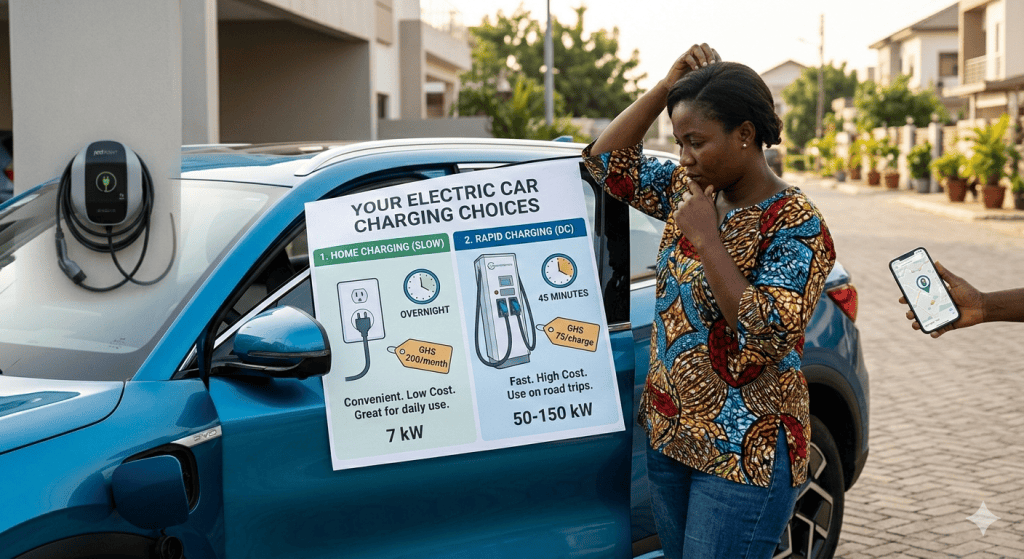
Ghana is taking an important step toward the electric vehicle future by finalising regulations for EV charging infrastructure. And frankly, this is one of those rare moments where government is trying to stay ahead of the curve instead of chasing the problem after it explodes.
Home charging should be the foundation
For most EV buyers in Ghana, the reality is simple:
home charging will remain the primary power source.
It’s cheaper, more convenient, and far more reliable than depending on public stations. Anyone considering an EV locally should already be thinking about:
- Stable electricity supply at home
- Safe wiring and installation
- Overnight charging routines
Without this, EV ownership becomes stressful.
But public charging is still essential
That said, if Ghana wants EV adoption to grow beyond early adopters, public charging must exist.
Not because every EV owner needs it daily, but because:
- It removes range anxiety
- It supports long-distance travel
- It enables people without private parking to go electric
- It builds confidence in the technology
Public charging isn’t about replacing home charging, it’s about making EV ownership viable for more people.
Why regulation now is the right call
This is where Ghana’s approach deserves credit.
Too often, new industries in the country grow in a regulatory vacuum until chaos sets in.
With EV charging, the government is trying something different:
- Setting technical standards early
- Clarifying licensing expectations
- Creating safety requirements
- Defining what investors must meet before entering the market
That matters a lot.
It gives investors certainty
For businesses looking to build charging networks, clarity is everything.
Regulations mean:
- Investors know the rules before spending money
- Infrastructure can be built to consistent standards
- The market avoids a flood of unsafe or incompatible equipment
In short, it makes the EV ecosystem investable.
It also protects EV owners
For buyers, these rules are more than paperwork.
They help ensure:
Chargers won’t damage vehicles Installations meet safety standards Equipment is compatible and reliable Investments in EVs aren’t undermined by poor infrastructure
That protection builds trust, and trust is what turns curiosity into adoption.
Bottom line
Ghana’s EV future won’t be powered by public chargers alone.
It will be powered by home charging first, supported by reliable public infrastructure.
By regulating early, the country has a chance to avoid the confusion seen elsewhere and build a system that works for drivers, investors, and the grid.
If Ghana gets this right, EV adoption won’t just happen, it will make sense.
Happy motoring…




Leave a Reply