
Modern cars are smarter than ever, but are we giving them the care they deserve?
Driving around Accra recently in this sweltering heat, I reached for my car’s air-conditioning controls. The system was working, but somehow the cooling wasn’t quite as enthusiastic as I wanted. I checked the settings. Everything was exactly where I normally leave it.
Then I noticed something on the dashboard. The car was in ECO mode.

Now, for those unfamiliar with ECO mode, it is a feature in many modern vehicles that adjusts how certain systems operate to improve fuel efficiency. Depending on the vehicle, it may soften throttle response, change transmission behaviour and even reduce the workload of the air-conditioning system.
Essentially, your car decides that saving you a little fuel is more important than turning the cabin into a refrigerator.
With Ghana’s heat doing its worst, I wasn’t particularly interested in that arrangement!
But this little experience got me thinking about something far more serious: how modern cars work and the rather casual approach we sometimes take to repairing them in Ghana.
Toyota Corolla Vs Volkswagen Golf
My friend, Fentuo Tahiru’s mechanic once replaced the air-conditioning compressor in his 2016 Toyota Corolla with one from a Volkswagen Golf MkII.
Yes, a Golf MkII!
Now, there is nothing inherently wrong with an old Golf compressor. It was designed to do a job, and in the right application it could do that job perfectly well. The problem is that it was designed for a very different generation of vehicle.
Compared with the technology used in more recent cars, the Golf’s compressor was something of a mammoth tooth.
You see, on many modern cars, an air-conditioning compressor isn’t simply expected to switch on and pump refrigerant. Its operation may be electronically regulated to suit the cooling demand, engine load and other operating conditions.
For example, when you select ECO mode in a suitably equipped car, the vehicle’s electronic control systems can reduce the air-conditioning compressor’s output. The blower fan may also run less aggressively. The precise arrangement varies from car to car, but the objective is the same: use less energy and save fuel.
Now imagine replacing an electronically controlled compressor with an older unit that doesn’t support the same functions.
The air-conditioning might work after some clever modifications, but will it respond correctly to the vehicle’s commands? Will it operate efficiently? What happens to its reliability, or to the other components connected to it?
Those are questions that must be answered before the replacement, not after something goes wrong.
And this brings me to a popular word in Ghanaian automotive repair circles: ALTERATION!
Today’s Car Is Basically a Computer Network on Wheels
Most people still think of a car as an engine, gearbox, four wheels and a collection of mechanical components.
That description is becoming increasingly outdated.
Modern cars are sophisticated electronic systems with numerous computers, technically called Electronic Control Units (ECUs), responsible for managing everything from the engine and transmission to braking, lighting, climate control and safety systems.
These computers communicate through electronic networks, including one known as CAN, or Controller Area Network.
Think of it like the computer network in an office. Different computers and devices exchange information so that everything works together.
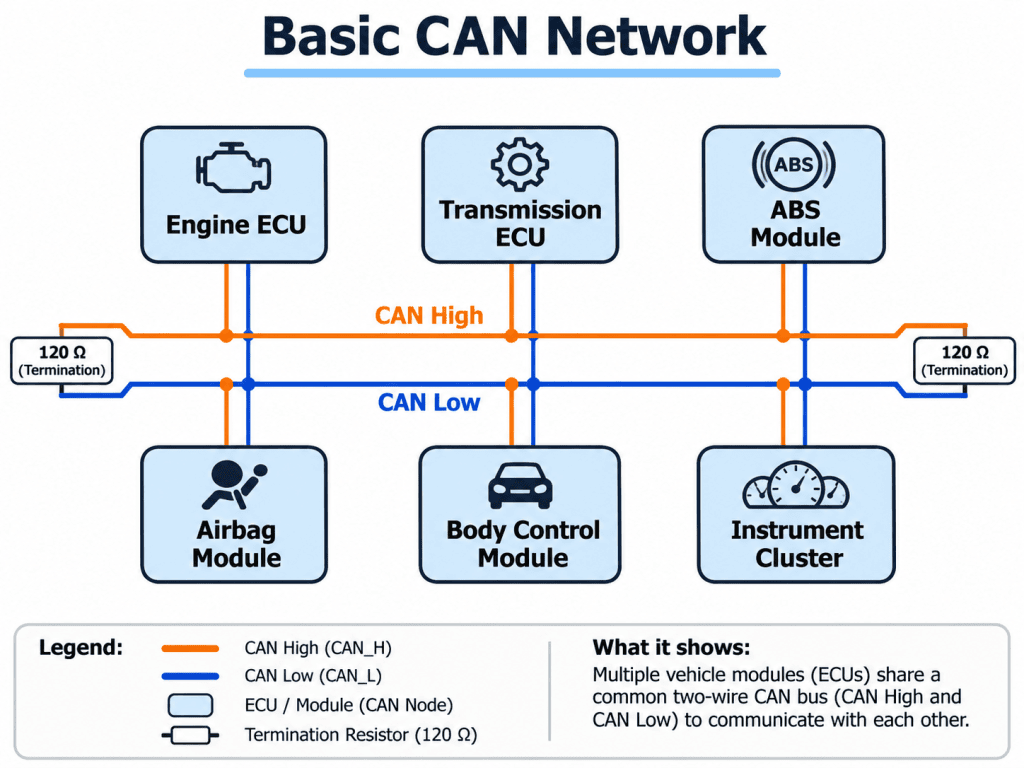
The technology was introduced by Bosch in 1986, with Mercedes-Benz among its early automotive pioneers in the early 1990s. By the 2008 model year, CAN had become the required communication protocol for standardised emissions-related vehicle diagnostics in the United States.
Today, depending on the model, a vehicle can have dozens of electronic control units, all working together.
Your engine computer may communicate with the transmission controller to coordinate gear changes. Your stability control system uses information about wheel speeds, steering angle and vehicle movement to help maintain control. Your air-conditioning system can adjust its operation based on engine load and cooling requirements.
And it gets even more interesting.
In some modern cars, replacing an entire headlight assembly or its electronic module may require special software to code or configure the replacement so that it works correctly with the vehicle.
Imagine that! Even a headlight may need a proper electronic introduction to the rest of the car.
When “It Fits” Doesn’t Mean “It Works”
In Ghana, we have developed an extraordinary culture of improvisation when it comes to vehicle repairs.
A part from one model is made to fit another. Electrical connections are modified, sensors are bypassed and components are adapted simply because they appear to perform a similar function.
Sometimes the mechanic’s ingenuity is genuinely impressive.
But here is the problem: mechanical compatibility does not automatically mean electronic compatibility.
A component may physically fit and even appear to work, yet fail to perform the full range of functions the manufacturer intended.
That can have consequences beyond the immediate repair.
An incorrect sensor could affect fuel consumption or engine performance. An unsuitable transmission component could interfere with gear changes. Poor electrical modifications could create intermittent faults that are extremely difficult to trace.
And when we start interfering with braking systems, airbags, steering and electronic stability control, the consequences could become a matter of life and death.
Modern vehicles are designed as integrated systems. Change one component without understanding how it interacts with the others, and you may create several new problems while attempting to solve one.
The frustrating part is that some of these faults don’t immediately reveal themselves. Your car may drive away from the workshop seemingly fine, only to develop strange behaviour weeks or months later.
Then begins that familiar Ghanaian motoring adventure: moving from one mechanic to another, replacing parts and spending money, hoping somebody eventually figures out what went wrong.
The Right Tools and Knowledge Matter
I have seen mechanics attempt complicated repairs with basic hand tools, guesswork and an impressive amount of confidence.
Now, let me be clear. There are exceptionally skilled independent mechanics in Ghana, and an expensive workshop is not necessarily a competent one.
But modern vehicle repairs require much more than mechanical experience.
A competent technician must understand the systems being repaired and have access to the appropriate diagnostic equipment, technical information and specialised tools.
A diagnostic scanner, for example, can help identify faults recorded by the vehicle’s computers. More advanced equipment can interrogate individual control units, monitor live data, perform tests, programme replacement components and carry out electronic calibrations.
However, owning a scanner does not automatically make someone a competent technician. The real skill lies in understanding what the information means.
Equally important is knowing when a repair requires equipment or expertise that a workshop simply doesn’t possess.
Consider modern vehicles equipped with automatic emergency braking, adaptive cruise control or lane-keeping assistance. Even replacing a windscreen or repairing a bumper can require recalibration of cameras or radar sensors.
These are not jobs to approach with guesswork.
Cheap Repairs Can Become Very Expensive
I understand why vehicle owners sometimes choose cheaper repairs.
Parts can be expensive, skilled labour costs money, and sourcing the correct component isn’t always easy.
That reality is particularly relevant in Ghana, where many motorists depend on used vehicles and imported replacement parts.
But there is a difference between saving money intelligently and taking an unnecessary gamble.
There is nothing fundamentally wrong with using quality aftermarket, professionally remanufactured or carefully selected used parts. In some situations, they offer excellent value.
What matters is that the replacement meets the vehicle’s requirements, is in suitable condition and is installed correctly.
A cheap repair that has to be repeated three times is not cheap. Neither is a modification that increases fuel consumption, creates electrical faults or compromises the safety of the vehicle.
And there is another cost we often overlook: the time wasted, inconvenience, stress and eventual loss of confidence in a car that has become unnecessarily unreliable.
Sometimes, the difference between a troublesome car and a dependable one is simply the quality of the people maintaining it.
Choose Your Mechanic Before You Choose Your Car
One of the most important decisions you should make when buying a vehicle is where and how you intend to maintain it.
Unfortunately, many of us put considerable effort into selecting a car, negotiating its price and admiring its features, but give very little thought to what happens when it needs servicing or repairs.
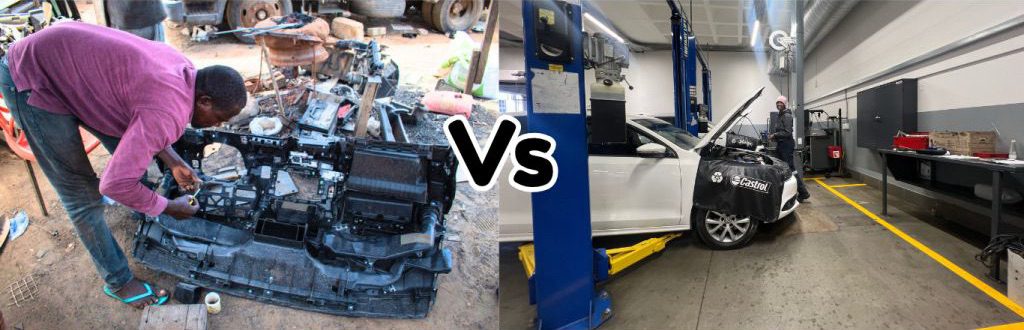
Before buying, particularly a modern or technologically sophisticated vehicle, find out whether competent technicians, suitable diagnostic equipment and the correct replacement parts are available.
And when your car needs repairs, ask questions.
- What exactly is wrong with the vehicle, and how was the fault diagnosed?
- Is the proposed replacement part compatible with my specific model and engine?
- Is the part genuine, aftermarket, remanufactured or used?
- Will the replacement require electronic programming, coding or calibration?
- What warranty or assurance comes with the part and repair?
A good workshop should be able to explain its recommendations without making you feel foolish for asking.
Don’t be impressed merely because a mechanic can make something fit. Be impressed because the mechanic understands why it belongs there in the first place.
We Must Change How We Maintain Our Cars
Automotive technology has progressed tremendously. Cars have become more efficient, safer, more comfortable and, in many respects, more reliable.
But the skills, equipment and maintenance culture required to keep them operating properly must evolve too.
Our automotive repair industry needs greater investment in technical training, proper diagnostic equipment, reliable parts sourcing and continuing professional development.
Vehicle owners also have a responsibility to demand better standards and stop treating proper maintenance as an unnecessary expense.
The era when almost any part could be adapted to almost any vehicle with a little cutting, welding and creativity is increasingly incompatible with modern automotive technology.
That doesn’t mean every modification is wrong. Well-engineered modifications exist, and knowledgeable specialists carry them out successfully. But there is a world of difference between engineering a solution and improvising one without understanding the consequences.
My little encounter with ECO mode reminded me just how much is happening behind the scenes whenever we drive.
Your car is constantly making decisions, exchanging information and adjusting its systems to deliver the experience its engineers intended.
The least we can do is ensure that the people working on it understand those systems.
After all, you invested good money in your car to enjoy trouble-free motoring, not to turn it into a permanent science experiment.
Happy Motoring……



Leave a Reply